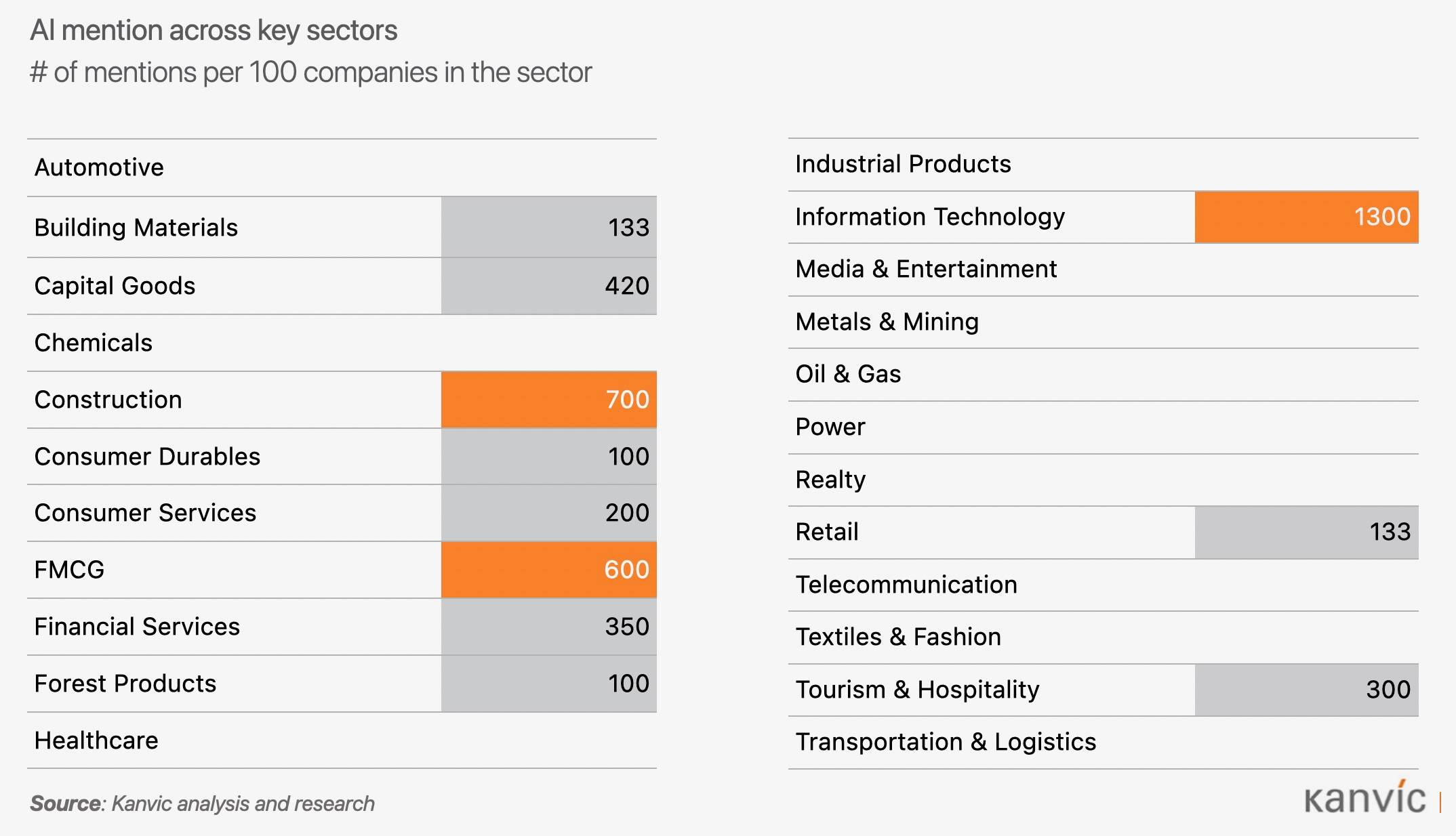
Information Technology remains the clear epicentre of AI discourse, with 1,300 mentions underscoring the sector's pivotal role as both the driver and testing ground for enterprise-scale AI adoption. This concentration is expected given the sector's technical capabilities and direct exposure to AI-driven business model disruption. What is more significant, however, is the breakout engagement emerging in traditionally non-technical sectors.
Construction demonstrates remarkable acceleration in AI engagement, with mentions surging from 300 in Q1 to 700 in Q2—a more than threefold increase that signals structural transformation in how this capital-intensive industry approaches operational efficiency and project management. Similarly, Tourism & Hospitality has shown noticeable movement, rising from virtually no AI mentions in Q1 to 300 mentions in Q2. This surge indicates that traditionally physical or service-heavy industries are beginning to embed AI into core operations and customer interfaces, fundamentally reshaping how they deliver value.
By contrast, Telecommunications presents a puzzling reversal. Once a strong AI adopter with 850 mentions in Q1, the sector recorded no AI mentions in Q2, suggesting either a stabilisation of AI initiatives following initial deployment or a strategic pivot toward other pressing operational themes. This divergence highlights the uneven pace of AI adoption across India Inc. and raises questions about sustainability of AI investments in sectors facing immediate operational pressures.
Sustainability Takes a Strategic Backseat
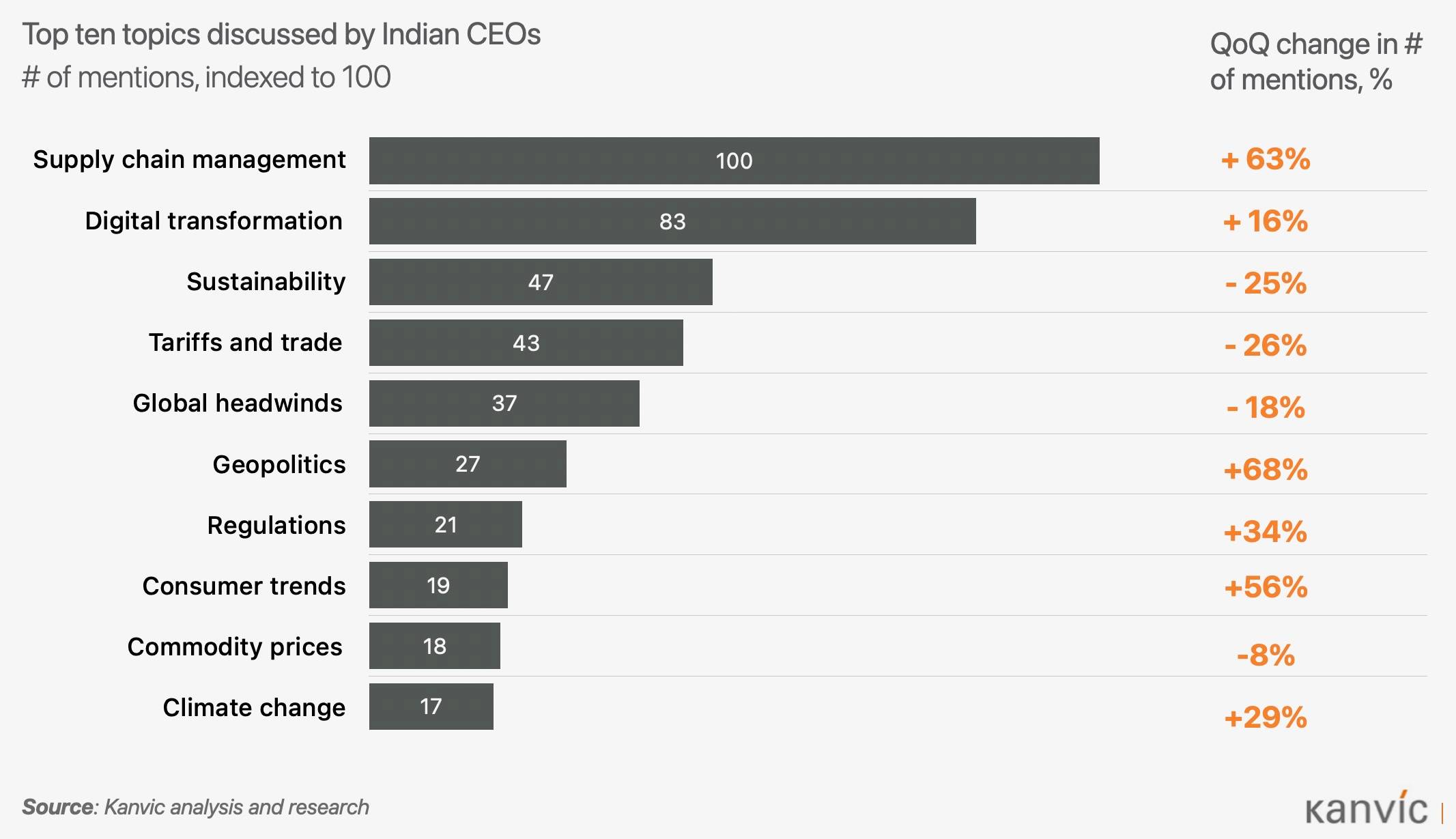
In a notable reversal of recent trends, sustainability mentions have declined 25% in Q2 2025. This reduction indicates that CEOs have temporarily reallocated their attention toward other business priorities, particularly growth acceleration and financial performance improvement in response to near-term operational pressures.
The decline does not necessarily signal abandonment of sustainability commitments but rather reflects a pragmatic recalibration of strategic priorities in a challenging macroeconomic environment. When faced with immediate pressures from trade tensions, supply chain disruptions, and margin compression, India Inc. leadership is prioritising initiatives that deliver near-term resilience over longer-term transformation agendas.
This temporal shift in strategic focus provides insight into how CEOs navigate competing priorities during periods of heightened uncertainty. The data suggests that while sustainability remains important to long-term value creation and stakeholder expectations, it becomes subordinate to operational imperatives when immediate business continuity is at stake.
Strategic Implications for India Inc.
The CEO Agenda Q2 2025 analysis reveals a decisive shift in India Inc.'s strategic priorities toward near-term operational resilience. The surge in supply chain discussions, the AI-driven acceleration of digital transformation, and the temporary deprioritisation of sustainability all point to a leadership cohort focused on strengthening controllable execution levers in response to external volatility.
This recalibration reflects mature strategic thinking: while long-term transformation agendas remain important, immediate operational resilience takes precedence when the business environment presents acute challenges. CEOs are demonstrating pragmatism in reallocating attention and resources toward initiatives that can deliver measurable impact in compressed timeframes.
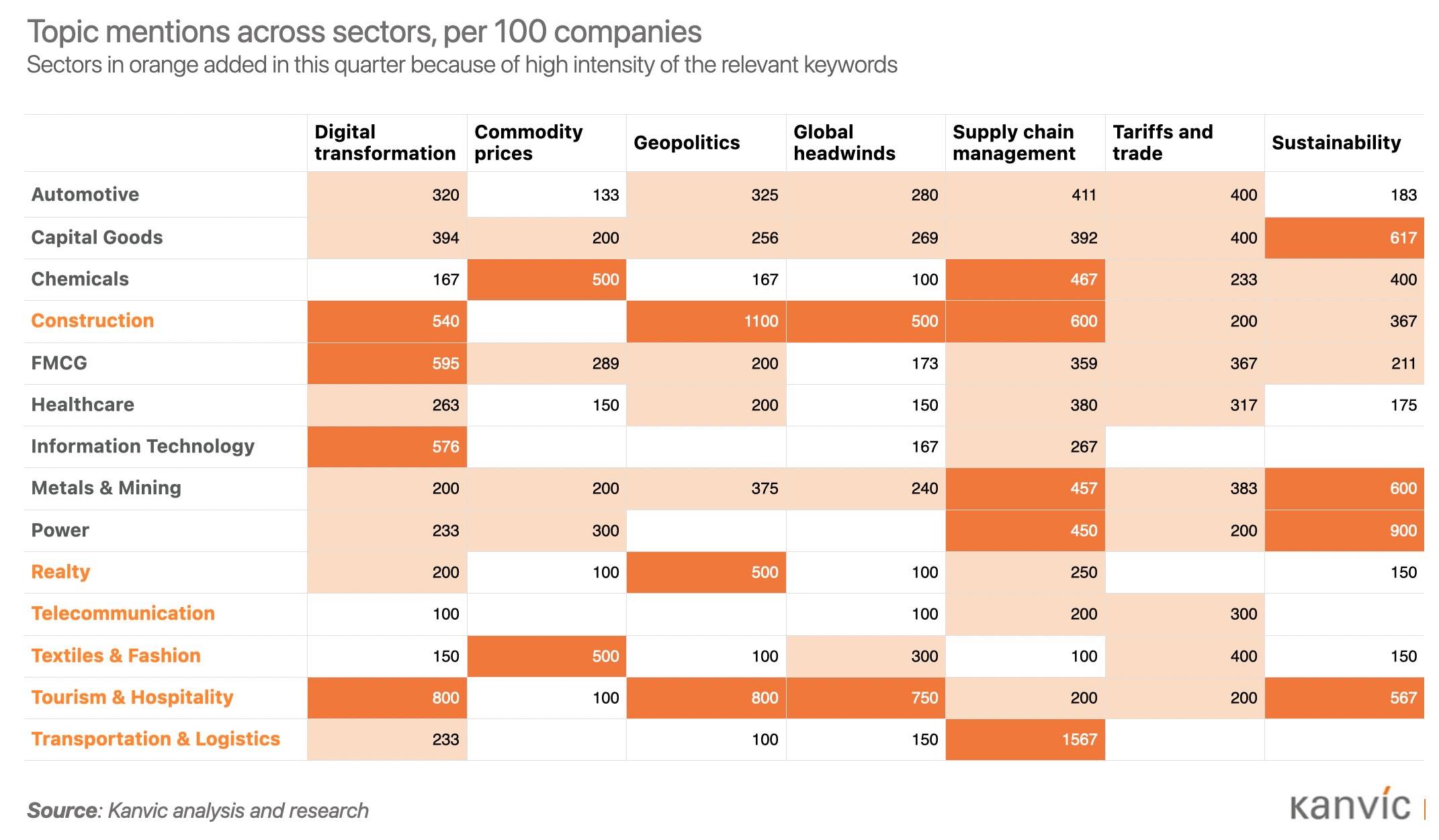
The cross-sectoral expansion of AI discussions, particularly the dramatic engagement increases in Construction and Tourism & Hospitality, signals that artificial intelligence is moving from a technology-sector phenomenon to a business-wide transformation imperative. This democratisation of AI adoption across traditional industries suggests that competitive differentiation will increasingly depend on successful AI integration, not merely in back-office operations but in core value delivery mechanisms.
The pervasiveness of supply chain discussions across all sectors confirms that operational resilience has become the defining strategic priority for India Inc. in Q2 2025. This focus on supply chain reconfiguration, capacity expansion, and geographic diversification reflects a fundamental reassessment of how businesses position themselves for sustained competitiveness in an era of persistent trade tensions and geopolitical fragmentation.
Most significantly, the quarterly shifts in CEO discourse reveal that India Inc. maintains a decisive bias toward action over analysis. Rather than awaiting environmental stabilisation, this bias toward execution mirrors the findings in our inaugural CEO Agenda: Decoding India Inc.'s Strategic Priorities. Business leaders are actively reshaping their operational footprints, accelerating technology adoption, and reconfiguring supply chains to build resilience. This execution-oriented mindset positions Indian businesses favourably for navigating continued uncertainty while maintaining competitive momentum in their respective markets.