Artificial Intelligence Consulting

Experiment. Build. Scale.

AI is advancing at a lightning speed but most Indian companies across sectors have yet to move beyond small experiments and isolated pilots. Kanvic's AI consulting services help you move from scattered pilots to scaling AI that generates tangible returns.

Driving AI adoption to deliver returns

Artificial intelligence has moved from an experimental technology to a boardroom agenda item. Kanvic Consulting research shows that the CEOs in more than 60% sectors are implementing AI initiatives in their businesses.

Generative AI and Agentic AI - systems that can plan and take multi-step actions with limited human intervention, are changing what automation and insight mean inside a business. But access to powerful AI technologies and models is not a constraint today. It is deciding which business problems are worth solving with AI, building the AI governance foundation to solve them safely, and integrating the result into how people actually work.

That is where Kanvic’s AI consulting services help our clients, by closing the gap between "we should look into AI" and "AI is measurably improving a business outcome."

Kanvic works with C-Suite leaders at each stage of that journey, from the AI readiness assessment through implementation and scaling AI. And we do this by translating business strategy into a prioritised set of AI use cases, combined with reimagined workflows with clear owners, metrics and controls .
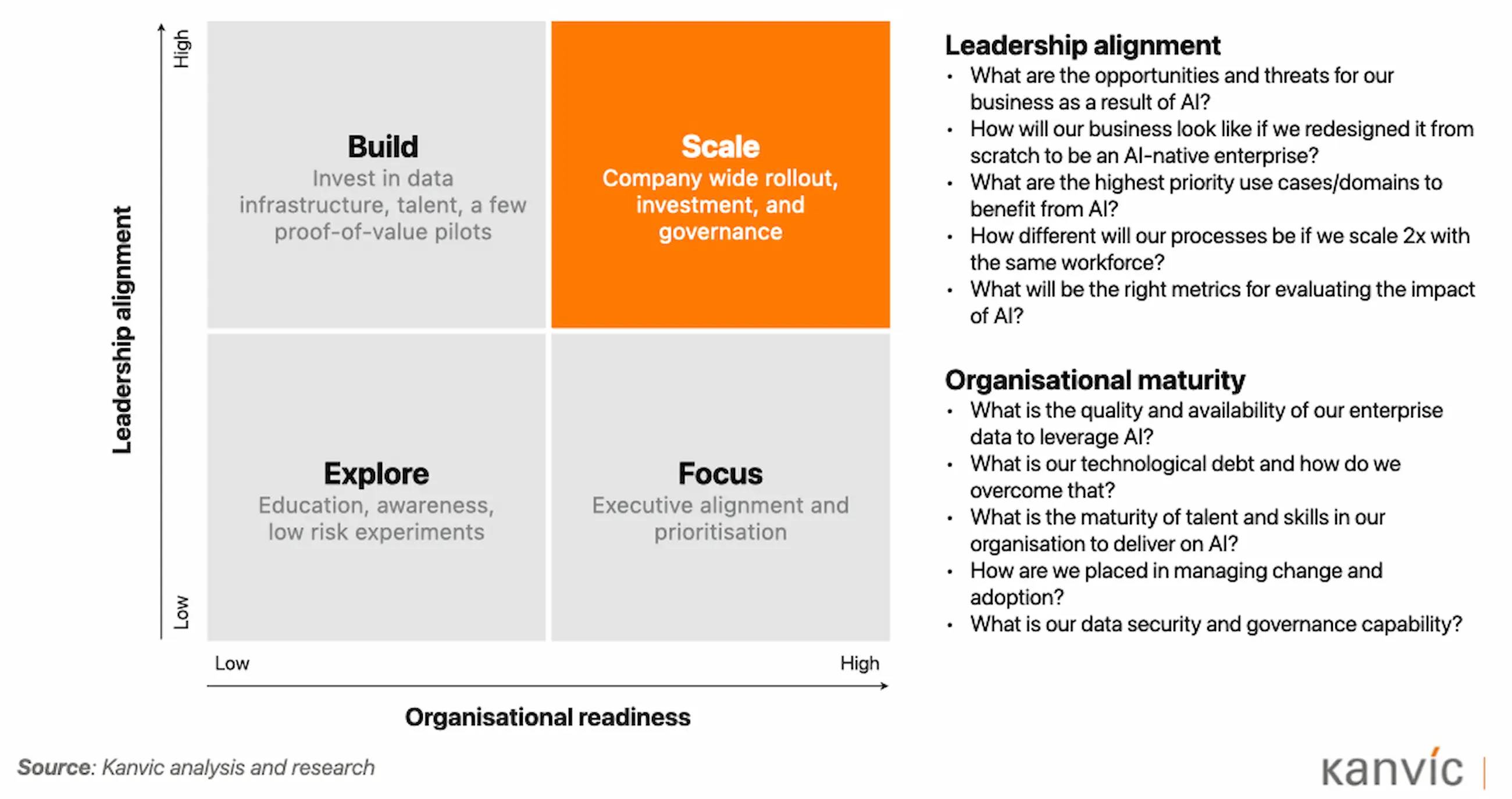
What is our Artificial Intelligence readiness assessment framework?

Kanvic AI Readiness Famework

How we help AI strategy consulting clients

Our AI consulting services cover the full journey in three steps, from the first strategy conversation to a capability your teams can run themselves.

Decide where AI will create value

Not every AI idea is worth pursuing. We first conduct AI readiness assessment to size the opportunity across functions and run structured discovery to surface use cases across your value chain. Each use case is then scored on business value, feasibility, data readiness and risk. For leaders who want to step back first, our CEO Workshop builds a clear view of how AI and other megatrends are reshaping competitive advantage.

Build the foundations to run AI

Our AI consultants design the target architecture, select the right models and platforms for each use case, and integrate them with your ERP, CRM, data platforms and core applications. For generative and agentic AI, we design the guardrails and human checkpoints, and the testing needed to prove what a system does on your behalf before you extend its autonomy.

Scale with adoption and governance

We then help you reimagine workflows, roles, and incentives, agree on the right metrics to track and design AI adoption strategy. Finally, we design AI governance framework to make AI trusted. In particular, we look at model risk, data privacy, security, fairness, explainability and human oversight to make AI safe to use.

How we help with AI adoption across sectors

Applying AI in FMCG to demand forecasting, trade promotion effectiveness, personalised marketing and sales team productivity, so that brands grow faster without growing cost to serve.

Using AI in retail for personalisation, pricing optimisation, store economics and customer experience across stores and digital channels.

Deploying AI in supply chain, predictive maintenance, quality inspection, and field service and supply planning, so that supply chains are resilient and plants run more reliably.

How does Kanvic approach AI engagements

Most AI programmes do not fail for lack of ambition or technology. They fail where strategy, data, delivery, people and governance fail to connect. Kanvic addresses each of these points by working in stages, with clear decisions at every step.

We apply business lens

Our recommendations are informed by a deep understanding of your strategy, operating model and commercial outcomes, not just by a technology trend. We are technology agnostic, so whether a vendor or model is the right fit or not, we say so.

We deliver ROI from AI

We work in stages with clear decisions to iterate, scale or stop. Before a pilot begins, we agree the baseline, a target tied to a named business owner and the threshold for scaling. We track early signals such as adoption, output quality and how often people override the AI, alongside results such as revenue, cost, and productivity.

We build your capability

Every AI consulting engagement includes a plan to transfer capability: the team, the training and an operating model that sets out who owns AI decisions, funding and risk. AI systems also degrade as models drift and data changes, so we help you build the discipline to monitor, retrain and extend your roadmap long after we have left.

Explore our other Digital & AI consulting services

Evaluate your organisation’s readiness to adopt and scale AI across digital strategy, technology, operating model, talent and culture, identifying capability gaps and execution risks.

Translate AI opportunities into a practical transformation roadmap, aligning business processes, technology and people to integrate AI into core operations and deliver measurable business value.

Unlock the value of internal and external data through predictive modelling, machine learning and high-impact analytics use cases that improve decision-making and strengthen AI-driven business performance.

Start your journey to success with Kanvic

TALK TO US

Key Artificial Intelligence questions leaders are asking today

Generative AI creates content on request, such as a draft, a summary or a block of code. Agentic AI works to achieve a goal. It plans the steps, uses tools and company systems, and acts with limited human intervention. The first assists a task. The second can run part of a workflow.

The difference matters commercially before it matters technically. Agentic AI moves the opportunity from helping individuals work faster to redesigning how whole processes run. It also changes the risk profile, because a system that acts, rather than assists, needs defined permissions, limits and escalation points.

Prioritise use cases by value they create for your business. Treat the decision as capital allocation and score each use case on key criteria such as:

  • Business value: Does the use case have a direct, quantifiable link to revenue, margin, productivity, or customer experience?

  • Data readiness: Whether the data needed is good enough today, without waiting for a long drawn data programme?

  • Feasibility: How hard it is to embed the use case in existing systems such as ERP and CRM?

  • Risk: What is the level of risk because of errors, biases, privacy breaches or false outputs?

Many pilots show impressive activity, such as model accuracy or user logins, yet cannot point to a tangible outcome in the P&L.

Leading companies take a disciplined approach to close the gap:

  • Build strong foundation: Data quality, system integration, workflow design, skills and governance framework help build the right foundation for scaling AI

  • Start with a baseline: Record the starting position before work begins, define the outcome and name a person accountable for the number.

  • Link AI benefits with business outcomes: Build a logical connection of AI impact with the business metrics e.g. if AI saves time, decide in advance whether the capacity is redeployed, avoided as cost or turned into growth.

Adoption is a people decision. And people use AI when it removes effort from their work and addresses their concerns. Companies can address AI adoption strategies by:

  • Involving people early on and make them part of the change.

  • Setting clear guidelines that define when employees should rely on AI and when they should challenge it.

  • Aligning performance measures and incentives with the redesigned process.

  • Aligning concerns about the impact on jobs and offering targeted re-skilling.

AI risk grows with autonomy, so controls must grow with it. A tool that drafts text creates limited exposure. A system that updates records, approves payments or contacts customers creates real liability. A useful first step is a simple diagnostic: where does AI already touch sensitive data or decisions in the business today, including tools that teams have adopted informally?

Leaders should build controls in four areas before scaling:

  • Data and intellectual property: Set clear rules on what data may be used, where it is processed, who can access it and how it is protected when working with external models.

  • Access and accountability: Limit each system to the access and actions it needs. Assign a named owner and an approval threshold wherever an error would be costly.

  • Regulatory exposure: Review data protection and sector-specific requirements at the design stage, not after the launch.

  • Reliability and monitoring: Performance can drift as data and conditions change. Use testing, audit trails and clear escalation routes so that problems are caught early.